Friday, 14 February 2014
Education XXV: to be aware of conditioning is the only way out of conditioning
He is still suffering the extreme fear produce by extreme violence. This suffering will condition him, possibly to be angry and-or violent.
Is it possible an education that favors an awareness of this conditioning, his homo sapiens conditioning, his genetic conditioning, the conditioning produced by the way his ancestors have lived (epigenetic), his cultural, familiar conditioning.....and the conditioning of suffering produced by the infinite conditioning of his fellow humans.
Is it possible to be completely aware of the WHOLE field of conditioning?
And maybe conditioning need not be something negative. Maybe is a necessary barrier that if we jump over would bring another state of mind, more pure, more fit.
I pray that you have it, little boy.......
Sunday, 27 January 2013
Emptiness. Education XXIV
But alcoholism is the result of complete empty lives....and wanting to fill this vacuum of a nihilistic society with women, alcohol, jobs
I do not want my twins to have this "vacuum" in their lives. Is there an education that could prevent that?
And it comes to my mind that yes, there is a role in education, in not giving unimportant values as supreme values, in having a reference in the sense of appreciating beauty, silence, in appreciating a nice person, in being sensitive........
Saturday, 21 April 2012
A second lesson from a two years old.....
Wednesday, 18 April 2012
a lesson from a two years old
The twins are now more than two years old. From time to time they keep competing and fighting for some objects. In those occassions there is some violence, in the form of biting or scratching the other. As they have not seen this in other people during their lifetime, I have to conclude that it is a "genetic" beheavior, something in their genes, a reflex written from our evolutionary past.So far I have tried to be calm in these occassions. It would be contradictory to use violence to teach them they should not be violent. I have tried that they see the suffering and pain caused in the other brother by their actions. Or I have asked them to look into my eyes while telling them I do not like they hurt each other.
But this behavior has continued happening, although occassionally.
The other morning, maybe because its repetition (there is always a "repetition" factor in our irritations), maybe because I had not slept enough (it seems it is our responsability to be well to relate well), one of those actions brought anger in me. I went for one of the twins, I grabbed him quite firmly and I raised my voiced to say "No". He was scared. I was using violence to teach non-violence, a contradiction (although frequently used with us). He closed his eyes, bent his head back, and I saw a expression of pain in his small mouth. He was hurt. By me.
At the beginning I thought I was right, but later a feeling of pain and sadness invaded me.
He had taught me two lessons:
- violence only engenders pain, in both sides. The incident produced deep pain in me and in him.
- It is quite easy to hurt a child.
- Violence can never teach non-violence.
He had been a master, taught me some good lessons. I am sorry. I have learned something......how easy is to be angry and how difficult to be compassionate......
Tuesday, 20 March 2012
Education XXIII, open mindness

The more I look at myself and look at people around, I realize that to acquire knowledge is relatively simple: to experience, study, read, practice, effort, will.....quite straightforward. But there are other more subtle qualities that seemed to me higher in nature, like to be open minded.
Is it possible an education that is conducive to be open minded?. To be open minded, it seems to me, first of all one has to question one's own conditioning: social, educational, family....even genetic conditioning.
But I am sure there are other things, like for instance: a mind that is open cannot rely in one's own opinions to have security...
And what else?
(picture by iqoncept)
Wednesday, 14 September 2011
Education XXII: How to educate to be compassionate?
I was looking at my twins (now 18 months old) and wondering what would be the "thing" that I would like that they have when they are older.And it came to my mind that above other things I would like that they have a "compassionate mind".
This is a term that I have heard mainly coming from buddhist people. But, I do not want that they are conditioned by a whole array of chants, concepts, writings, methods, etc, as it seems to me that all those things have been added over time, as layers, to something quite simple (by the way, is there such a thing as "simple, pure, buddhism?).
So the question is: how to educate compassion?. Is it something that one can give to, produce, provoque? or is it something that is already there and has to be un-covered?
This, to me, is such an important question in education. All the rest is very secondary.
Wednesday, 27 July 2011
Education XXI, Socrates

HIPPOCRATES: You are right, my dear Socrates, as always. But won't you put aside your method this time and tell me the answer immediately?
SOCRATES: No, my friend, even if I could, I would not do this, and it is for your sake. The knowledge somebody gets without work is almost worthless to him. We understand thoroughly only that which - perhaps with some outside help - we find out ourselves, just as a plant can use only the water which it sucks up from the soil through its own roots.
(from "A socratic dialogue in mathematics" by Alfred Renyi)
Tuesday, 5 July 2011
Education XX: rewards

Yesterday it was a very hot day. We were going by car to swim in a lake in the mountains. The twins (almost 16 month old now) were in their seats on the back. And suddenly one of them started blowing air into a harmonica.
It was just blowing in and out, but I like the sound and the fact that he was producing it. And both his mother and I started saying "very good", "great" with a very friendly tone of voice. And he stopped "playing" and laughed.
It was clear that he like we praising him, it was a reward. And then I thought that I would like that he likes to play music by itself, not by the reward that it might bring him. And how often we have been educated like this, through reward and punishment. And then we end up doing something not by the thing itself, but because we like the reward.....and that might create a lot of confusion and suffering.
Monday, 16 May 2011
Education XIX: how easy is to put fear in a child´s mind
These last days something happened that was interesting. One of the twins (14 months old) started to be quite afraid and concerned about helicopters. It all started because whenever a copter flew past above us, we would point our hand towards it and changed our normal tone of voice and said "Look, helicopter". We uncounsciously changed our tone of voice to make it more interesting.But know we are a bit worried, because whenever there is a helicopter, or he even hears the word "helicopter", he says "Uh, Uh" and looks worried and afraid.
So, we realized how easy is to put fears in a child´s mind, and how easy they pick up these fears. It feels as if their mind is quite receptive to incorporate fears. It is fertile ground to let these fears root in it. This is something we have to have in mind if we do not want to educate through fears, to put fears in their minds....so they are safe....
Tuesday, 5 April 2011
Education XVIII: Where do speak, act FROM?
" Because you are free and understand freedom, you will be punctual in your class and from freedom you will talk to the student and not from an idea. To talk from an idea, a formula, a concept is one thing, but to talk from an actual fact which you have seen - that the student must be free and therefore orderly - is totally different. When you as a teacher are free and orderly you are already communicating it, not only verbally but non-verbally and the student knows it immediately.
Once you see the fact that punishment and reward in any form are destructive, you never go back to them. By throwing them out, you yourself are disciplined and that discipline has come out of the freedom of examination. You communicate to the child the fact of that and not any idea. Then you have communicated to him not only verbally, but at a totally different level."
And a question came to my mind: Where are we speaking FROM?, Wherea are we acting FROM?
Tuesday, 22 March 2011
Education XVI: the world is the teacher
I was watching one of my twins trying to climb a rock. He was getting better and better at it, was quite determined about it, and showed a great joy at trying it.And an idea came to my mind: The real techer is not a person in a school..... the real teacher is the world. All is there.
And then I thought: Yes, two elements are the main teachers, and they are enough to learn it all. One is the world, and the other the capacity to look, not only outwardly, but more importantly inwardly.........
(photograph from: http://parkerlab.bio.uci.edu/nonscientific_adventures/canyonland_arches.htm)
Wednesday, 9 March 2011
Education XV: behaviour 2
".....So there has to be affection, a sense of tenderness, kindliness, generosity. If there is such affection, then behaviour is dictated by that affection and is not dependent on environment, circumstance, or people. And to find that affection is one of the most difficult things .......
...... And so to have affection right through life is one of the most difficult things and without it life becomes very empty. You may have children, you may have a nice house, a car and all the rest of it, but without affection life is like a flower that has no scent. And it is part of education, is it not, to come to this affection, from which there is great joy, from which alone love can come?
Monday, 7 March 2011
Education XIV: behaviour

One of the most difficult things in life is to find a way of behaviour that is not dictated by circumstances. Circumstances and people dictate, or force you to behave in a certain way. The way you conduct yourself, the way you eat, the way you talk, your moral, your ethical behaviour depend on where you find yourself and so your behaviour is constantly varying, constantly changing.
This is so when you speak to your father, your mother or to your servant - your voice, your words, are quite different. The ways of behaviour are controlled by environmental influences, and by analysing behaviour you can almost predict what people will do or will not do.
Now can one ask oneself if one can behave the same inwardly, whatever the circumstances? Can one's behaviour spring from within and not depend on what people think of you or how they look at you? But that is difficult because one does not know what one is within. Within, a constant change is going on also. You are not what you were yesterday.
Now can one find for oneself a way of behaviour which is not dictated by others or by society or by circumstances or by religious sanctions, a way of behaviour that does not depend on environment?
(J. Krishnamurti "On Education", chapter 9)
Good point to ask ourselves and to raise in an educational setup
Friday, 4 March 2011
Education XIII
Student: If you have lots of time, how would you spend it, Sir?Krishnamurti: I would do what I am doing. You see, if you love what you are doing, then you have all the leisure that you need in your life. Do you understand what I have said? You asked me what I would do if I had leisure. I said, I would do what I am doing; which is to go around different parts of the world, to talk, to see people and so on. I do it because I love to do it; not because I talk to a great many people and feel that I am very important. When you feel very important, you do not love what you are doing; you love yourself and not what you are doing. So, your concern should be not with what I am doing, but with what you are going to do. Right? I have told you what I am doing. Now you tell me what you will do, when you have plenty of leisure.
(Krishnamurti in "on education", chapter 8)
Wednesday, 23 February 2011
Education XII. What is to learn from oneself and from outside?
It seems so important in education to learn about the world inside us, and the world outside......which means to "look" inside and to "look" outside.......Maybe they are not different....... it seems to me, if the looking inside and outside is the same, that is the "unifying" factor..........This is the crucial question......how to look?
We are reading the book "on education" by J. Krishnamurti (where he is talking to young students) in the other blog, and so far there has been 3 occasions in which he describes meditation, which probably is this "looking".
Let's put these 3 pieces together to have a look at its beauty:
- "You must know fear and not escape from it so that you can look at fear. It is like going for a walk and suddenly coming upon a snake, jumping away and watching the snake. If you are very quiet, very still, unafraid, then you can look very closely, keeping a safe distance. You can look at the black tongue and the eyes that have no eyelids. You can look at the scales, the patterns of the skin. If you watch the snake very closely you see and appreciate it and perhaps have great affection for that snake. But you cannot look if you are afraid, if you run away"
- "Have you ever sat on the banks of a river and watched the water go by? You cannot do anything about the water. There is the clear water, the dead leaves, the branches. You see a dead animal go by, and you are watching all that. You see the movement of the water, the clarity of the water, the swift current of the water and the fullness of the water. But you cannot do anything. You watch and you let the water flow by"
- To learn about meditation, you have to see how your mind is working. You have to watch, as you watch a lizard going by, walking across the wall. You see all its four feet, how it sticks to the wall, and as you watch, you see all the movements. In the same way, watch your thinking. Do not correct it. Do not suppress it. Do not say, "All this is too difficult". Just watch
Friday, 18 February 2011
Education XI. Not just ideas, concepts.....
And I was listening in the car dialogue number 13th of "The ending of time" between David Bohm and J. Krishnamurti, and a section of this dialogue was something like this:
"K: So you see it is enormously difficult to be free of knowledge.
DB: We could ask, why doesn't knowledge wait until it is needed?
K: That means to be psychologically free of knowledge, but, when the need arises, to act from freedom, not from knowledge.
.........
K: That is freedom from knowledge. And being free, it is from freedom and not from knowledge that one communicates.
K:....... And if I am going to understand myself, I must be free to look."
And at that moment it flashed in my brain that we have been educated in ideas, in concepts, in opinions. A tremendous importance has been given to that, probably because this is the way our brain works...... I studied history and it was all knowledge, opinions about what had happened, who was "good" or "bad", all a virtual reality...and I realize I continue in my adult life living in a world of ideas, concepts......
Would it be possible to be aware of this and educate not giving so much importance to concepts, ideas....and educate giving importance to something real?
(No idea how, but the clarity about this need is there.....)
(photograph from the actual place described above, made yesterday by S. de Ch.)
Monday, 7 February 2011
Education X. The appreciation of beauty.
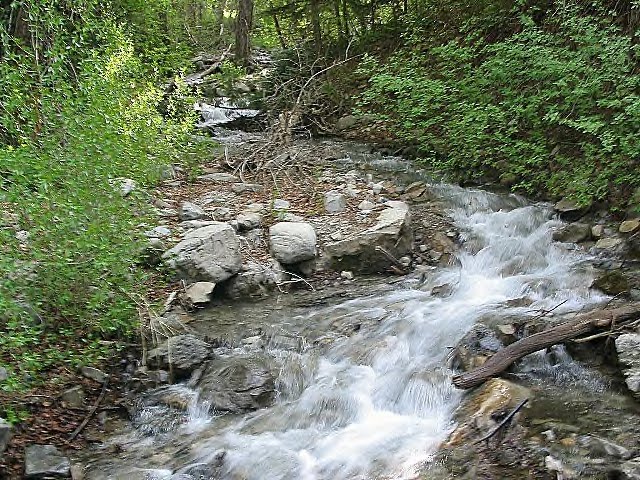
Two days ago I took my twins to the mountains. They are 10 month old. We went into a beautiful valley, there was snow, but the valley was wide and full of sun light. And it was very silent. Although both of them were at the beginning somehow agitated, slowly they quiet down, somehow they "melted" into the general quietness of the place.I was carrying one of them in a kid carrier, on my chest. At one point I stopped to look at a small water stream. I was looking at the stream and something unexpected happened. I heard him giggling. I looked at him and he was looking at the water stream and smiling and giggling with excitement.
And I realized he was happy appreciating the beauty of the stream.
I always thought it was very important in education to educate to appreciate beauty. I did not know how. But when I heard my son giggling at the water stream, I realized the "seed" of appreciation of beauty is already there, probably in all of us. We do not need to educate for it. We just need to expose children to beauty....and in that interaction beauty will act on the "seed"...and make it germinate....
(no need to educate, no need for sophisticated approaches and educational techniques......all the material is already there....the seed and the beauty.......and, now, writing this, I have a doubt, a question: the seed and beauty, are they different, separate, things?.....)
(dedicated to N.C.D.)
Thursday, 11 November 2010
Education IX
I read Krishnamurti´s book "On education". The very first entry starts with such a beautiful text:You know, you live in one of the most beautiful valleys I have seen. It has a special atmosphere. Have you noticed, especially in the evenings and early mornings, a quality of silence which permeates, which penetrates the valley?........and wherever you go, in cities or in other places, man is destroying nature, cutting down trees to build more houses, polluting the air with cars and industry......but probably you have become used to it. You do not look at the hills any more, you do not listen to the birds any more and to the wind among the leaves. So you have gradually become indifferent.....
Education is not only learning from books, memorizing some facts, but also learning how to look, how to listen.....Education is not just to pass examinations, take a degree and a job, get married and settle down, but also to be able to listen to the birds, to see the sky, to see the extraordinary beauty of a tree, and the shape of the hills, and to feel with them, to be really, directly in touch with them. As you grow older, that sense of listening, seeing, unfortunately disappears because you have worries, you want more money, a better car, more children or less children. You become jealous, ambitious, greedy, envious; so you lose the sense of the beauty of the earth....... And you will grow up to fit into this. Is this right, is this what education is meant for, that you should willingly or unwillingly fit into this mad structure called society?
..... you will conform, because that is the easiest way to live.....You have to change society.... Society is you and I. You and I create the society in which we live. So you have to change..... And you, living in this extraordinary valley,.....Are you going to conform, fit in, accept all the old values? ....... But if you now begin to think, to observe, to learn, not from books, but learn for yourself by watching, listening to everything that is happening around you, you will grow up to be a different human being - one who cares, who has affection, who loves people. Perhaps if you live that way, you might find a truly religious life.....
Do you know what it means to attend, to pay attention? ..... See the totality of the tree. Look at it that way, because I am going to talk about something to which you have to pay attention. Attention is very important, in the class, as well as when you are outside, when you are eating, when you are walking. Attention is an extraordinary thing.
I am going to ask you something. Why are you being educated? Do you understand my question? Your parents send you to school. You attend classes, you learn mathematics, you learn geography, you learn history. Why? Have you ever asked why you want to be educated, what is the point of being educated? What is the point of your passing examinations and getting degrees? Is it to get married, get a job and settle down in life as millions and millions of people do? Is that what you are going to do, is that the meaning of education? ....Human beings throughout the world.....are being educated to conform, to fit into society and into their culture, to fit into the stream of social and economical activity, to be sucked into that vast stream that has been flowing for thousands of years. Is that education, or is education something entirely different? Can education see to it that the human mind is not drawn into that vast stream and so destroyed; see that the mind is never sucked into that stream; .....That stream is our culture. So, the question is how to bring about the right kind of education so that the mind can withstand all temptations, all influences, the bestiality of this civilization and this culture.
We have come to a point in history where we have to create a new culture, a totally different kind of existence, .....but a culture based upon a real quality of religion. Now how does one bring about, through education, a mind that is entirely different, a mind that is not greedy, not envious? How does one create a mind that is not ambitious, that is extraordinarily active, efficient; that has a real perception of what is true in daily life which is after all religion.
(.....means a part of the text has been edited out. If you want to read the whole text go to: http://www.jkrishnamurti.org/krishnamurti-teachings/view-text.php?tid=43&chid=297&w=krishnamurti+%22on+education%22)
It seems to me such an important book, that I feel one should not just read it, but STUDY it. And why not study it together with other people?. So, I opened a new blog, called "Studying Krishnamurti". You can see it here.
I transcribe here some of the intentions of this blog:
"Why study? What is to study? To study is to try to realize the full meaning originally intended in a text. To study is to go SLOWLY over the text, with an open mind, suspending our conditioning, and letting the meaning of the text emerge (both locally as a sentence and as whole text). It has nothing to do with casually reading....
Why together? It is our experience that a group of people reading the same text together and commenting what they read, is like looking from many different angles. This way of reading has always worked very well. With the advent of internet, it is hoped that people from very far, unlikely to get physically together, could "come together" and study something together....
This blog does not belong to anybody in particular. It belongs to the people using it. Anybody can suggest a book or an audio or even a video tape, to be studied together. Moderation will be kept to a minimum.
For the people that do not have the paper book, it will be suggested where to download it. In this case, it is suggested that a small donation is made to the corresponding foundation."
Thursday, 14 October 2010
Education VIII
Can we see the limitations of a shallow mind?.....And can we have a feeling for a mind that has space, a big space....that is not narrowed by spinning continously around something, that is not full of worries and fears about security, that is not narrowed too much by the sense of "being somebody"......that can see all the limitations, that can see its own space....
But can one educate to have such "big space" mind?...... How?.....
(picture: "Shallow Water" (6x8") oil painting by Todd Bonita)
Wednesday, 6 October 2010
Education VII

Last night I saw a beautiful and inspiring film: "How to cook your life" (2007). Zen cook and monk Edward Espe Brown explains how to prepare bread and other foods.
But it is not only about food. Brown interlaces the preparation of food to topics as anger, anxiety, the mind and suffering.
This is how education has to be understood, and Edward Espe Brown acts as a real educator. He takes a seemingly simple act (as cooking), and uses it to go to very real and deep subjects of everyday life.
Watching the film several points popped up in my mind:
- A real teacher is not the product of many clever courses about (alternative or wholistic) education. It is the depth of the person who is a teacher that makes a difference.
- What is the role of religious people in a new kind of education? Should they come out of their monasteries and get more involved in education?
- Education cannot be just passing information-knowledge. Edward Espe Brown takes one subject like cooking and explores the relationship of the student with the subject, the relationship between the people in the class/group, the relation of the students with their own mind and the relationship of the student´s mind with life in general. And still learning something technical, like bread making, in a highly skilled way. One highlight of the film is when he refers to the bumps that have the metal tea pots, and he says they are a symbol for a person, as life inevitably produces bumps on you, but he refers to the dignity of the tea pots still serving its function.
- Another thing that popped in my mind, a bit unrelated to the film, was that if we want to send our children to a school, we should know the school really thoroughly, not just by references. In that sense, schools should offer some classes to the parents, so one could know firsthand the school and the teachers.
You could see a small clip of this film here.