Thursday, 26 May 2011

Freedom, problems


"The other day when we met here, I was talking about the necessity of freedom; and by that word freedom I do not mean a peripheral or fragmentary freedom at certain levels of one's consciousness. I was talking about being totally free - free at the very root of one's mind, in all one's activities, physical, psychological, and parapsychological. Freedom implies a total absence of problems, does it not? Because when the mind is free, it can observe and act with complete clarity; it can be what it is without any sense of contradiction. To me, a life of problems - whether economic or social, private or public - destroys and perverts clarity. And one needs clarity. One needs a mind that sees very clearly every problem as it arises, a mind that can think without confusion, without conditioning, a mind that has a quality of affection, love - which has nothing whatever to do with emotionalism or sentimentality.

To be in this state of freedom - which is extremely difficult to understand, and requires a great deal of probing into - one must have an undisturbed, quiet mind; a mind that is functioning totally, not only at the periphery, but also at the center. This freedom is not an abstraction, it is not an ideal. The movement of the mind in freedom is a reality, and ideals and abstractions have nothing whatsoever to do with it. Such freedom takes place naturally, spontaneously - without any sort of coercion, discipline, control, or persuasion - when we understand the whole process of the arising and the ending of problems. A mind that has a problem, which is really a disturbance, and has escaped from that problem, is still crippled, bound; it is not free. For the mind that does not resolve every problem as it arises, at whatever level - physical, psychological, emotional - there can be no freedom and therefore no clarity of thought, of outlook, of perception.

Most human beings have problems. I mean by a problem the lingering disturbance created by one's inadequate response to a challenge - that is, by the incapacity to meet an issue totally, with one's whole being - or by the indifference which results in the habitual acceptance of problems and just putting up with them. There is a problem when one fails to confront each issue and go to the very end of it, not tomorrow or at some future date, but as it arises, every minute, every hour, every day."

(J. Krishnamurti, Second Talk in Saanen, 1964)

Can we have a "taste" of the vastness he is talking about?

(picture titled "dessert storm", courtesy of Gerry Johnson, http://www.gerryjohnsonphotography.com )


Monday, 16 May 2011

Education XIX: how easy is to put fear in a child´s mind

These last days something happened that was interesting. One of the twins (14 months old) started to be quite afraid and concerned about helicopters. It all started because whenever a copter flew past above us, we would point our hand towards it and changed our normal tone of voice and said "Look, helicopter". We uncounsciously changed our tone of voice to make it more interesting.

But know we are a bit worried, because whenever there is a helicopter, or he even hears the word "helicopter", he says "Uh, Uh" and looks worried and afraid.

So, we realized how easy is to put fears in a child´s mind, and how easy they pick up these fears. It feels as if their mind is quite receptive to incorporate fears. It is fertile ground to let these fears root in it. This is something we have to have in mind if we do not want to educate through fears, to put fears in their minds....so they are safe....

Saturday, 7 May 2011

The obsolete consciousness VIII


This separation in beleifs, in religions, in nations, in groups. This apparent wanting "the best for the people, for the world", no matter the method used. This lack of respect for life and for human lives. This lack of compassion. This deep conviction that we are separated....
All this is a sign of an obsolete consciousness. We should not judge this as right or wrong, but maybe we should see it at another level, as symptoms of obsolescence in our consciousness, of which we are also a part....
This realization may be an alternative......

Saturday, 30 April 2011

denying time

"So can my mind refuse to use time and deny time as a means to mutation? Do you see the beauty of it? Then what takes place?

The thing which I want changed has been put together through time, it is the result of time, and I deny time. Therefore I deny the whole thing and therefore mutation has taken place. I do not know if you see this. It is not a verbal trick.

Have you understood it? If I deny my conditioning as a Hindu, which is the result of time, and I deny time, I deny the whole thing. I am out of it. If I deny ritual - the Christian, Hindu or Buddhist - deny it because it is the product of time, I am out. I do not have to ask how to bring about mutation. The thing itself is the result of time and I deny time - it is finished."

"
A mind that functions in time is still a limited mind. But a mind which does not function in time is extraordinarily alert"

"You have to understand the quality of a mind in which mutation has taken place. It has taken place the moment you deny time. You have thrown the whole past out. You are no longer a Hindu, a Christian."

(J. Krishnamurti, "On education",
pages 82 and 83)

"Time" is not an abstract concept in physics. Here he is using the term as something very concrete: our conditioning. And that conditioning determines the way we live the present and project the future.

And what is to "deny"? To deny is to be fully aware of that conditioning, without judging it. Are we fully aware, without judging, of the whole field of our conditioning? Are we totally aware/realize that the way our brain works is in this field of time, which is just conditioning moving from past to present to future? Are we fully aware/realize that when we live/see something is with the past, which is completely conditioned?

And to be completely aware of it, is to be out of it, to "deny" it, because this awareness is not conditioned.

And until we see this, we cannot "be in the present".... by just an act of will.....

This is how I took it to mean today, but maybe some other people see it in another way......

Friday, 8 April 2011

Unhappiness

I was in my office today and it was the turn for a middle age woman. She told me she had fainted three times today after vomiting. I asked her if in general she was eating well, sleeping well. She told me yes. She was of arab origin, nice facial features, but there was unhappiness painted in her eyes and the edges of her mouth. I asked her if she was content with her life. Then she said no with her head and started sobbing.

And an idea flashed in my mind. This happiness/unhappiness existed in the world of emotions. But in the "world of awareness", unhappiness did not exist (or happiness for that matter)......

Tuesday, 5 April 2011

Education XVIII: Where do speak, act FROM?

We were reading/studying Krishnamurti´s text "On Education", and on page 71, he says:

" Because you are free and understand freedom, you will be punctual in your class and from freedom you will talk to the student and not from an idea. To talk from an idea, a formula, a concept is one thing, but to talk from an actual fact which you have seen - that the student must be free and therefore orderly - is totally different. When you as a teacher are free and orderly you are already communicating it, not only verbally but non-verbally and the student knows it immediately.

Once you see the fact that punishment and reward in any form are destructive, you never go back to them. By throwing them out, you yourself are disciplined and that discipline has come out of the freedom of examination. You communicate to the child the fact of that and not any idea. Then you have communicated to him not only verbally, but at a totally different level."

And a question came to my mind: Where are we speaking FROM?, Wherea are we acting FROM?

Sunday, 3 April 2011

Awareness and existence

I was reading one of Ramana´s books, and I found this sentence:

"Do you remember, I told you once previously that existence and awareness are not two different things but one and the same?"

("Maharshi´s Gospel", page 94)

Saturday, 26 March 2011

Education XVII: what we bring from our evolutionary past

My twins are now 1 year and 15 days old. Since they were 9 month old I have observed something in their behaviour which I find very interesting.

One is playing with, say, a small bottle, he is examining it, bringing it to his mouth. Then the other sees that object and comes to take the bottle from the other twin. Then screaming breaks out and the one having the bottle bites the other in the hand or the face or even the head. Sometimes biting is quite hard and painful. Both of them show this behavior. Of course, it does not happen all the time, it is a minority of times, but it happens.

Obviously, they have not seen this behaviour from us....so this reaction is not learned but it has to come in their genes, from their evolutionary past......

Many things are involved in this kind of incidents: a sense of possesion, a sense of me (I am possesing this object and somebody else, separate, comes to take it away), and violence, come in-built in our genes....they are expressions of our evolutionary history.......is a kind of evolutionary conditioning...acting all our life.....

Tuesday, 22 March 2011

Education XVI: the world is the teacher

I was watching one of my twins trying to climb a rock. He was getting better and better at it, was quite determined about it, and showed a great joy at trying it.

And an idea came to my mind: The real techer is not a person in a school..... the real teacher is the world. All is there.

And then I thought: Yes, two elements are the main teachers, and they are enough to learn it all. One is the world, and the other the capacity to look, not only outwardly, but more importantly inwardly.........

(photograph from: http://parkerlab.bio.uci.edu/nonscientific_adventures/canyonland_arches.htm)

Tuesday, 15 March 2011

real freedom


I go to work and in the car I listen to D. Bohm and Krishnamurti dialogue number 15, towards the end of it there is a part that I found remarkable:

K: .....................It means he must listen to me, but my brother refuses to listen.

DB: It seems that there are some actions which are not possible. If a person is caught in a certain thought such as fragmentation, then he can't change it, because there are a lot of other thoughts behind it.

K: Of course.

DB: Thoughts he doesn't know. He is not actually free to take this action because of the whole structure of thought that holds him.

And that sparks an idea in my mind: "Maybe real freedom is just to listen, to listen completely, because when you listen completely, there are no thoughts, no influences from my structure, from my past......and in those moments I am free of them..........

Friday, 11 March 2011

tsunami

My afection and solidarity for everybody that is suffering by today's tsunami.....we feel close to you.....

I think we are heading towards a world that feels like a unity....

(lower picture: children in Ahmedabad, India, by Amit Dave)

Wednesday, 9 March 2011

Education XV: behaviour 2

And keeping reading an answer came, a bit in an unexpected twist:

".....So there has to be affection, a sense of tenderness, kindliness, generosity.
If there is such affection, then behaviour is dictated by that affection and is not dependent on environment, circumstance, or people. And to find that affection is one of the most difficult things .......
...... And so to have affection right through life is one of the most difficult things and without it life becomes very empty. You may have children, you may have a nice house, a car and all the rest of it, but without affection life is like a flower that has no scent. And it is part of education, is it not, to come to this affection, from which there is great joy, from which alone love can come?

Monday, 7 March 2011

Education XIV: behaviour


One of the most difficult things in life is to find a way of behaviour that is not dictated by circumstances. Circumstances and people dictate, or force you to behave in a certain way. The way you conduct yourself, the way you eat, the way you talk, your moral, your ethical behaviour depend on where you find yourself and so your behaviour is constantly varying, constantly changing.

This is so when you speak to your father, your mother or to your servant - your voice, your words, are quite different. The ways of behaviour are controlled by environmental influences, and by analysing behaviour you can almost predict what people will do or will not do.


Now can one ask oneself if one can behave the same inwardly, whatever the circumstances? Can one's behaviour spring from within and not depend on what people think of you or how they look at you? But that is difficult because one does not know what one is within. Within, a constant change is going on also. You are not what you were yesterday.

Now can one find for oneself a way of behaviour which is not dictated by others or by society or by circumstances or by religious sanctions, a way of behaviour that does not depend on environment?

(J. Krishnamurti "On Education", chapter 9)

Good point to ask ourselves and to raise in an educational setup

Friday, 4 March 2011

Education XIII

Student: If you have lots of time, how would you spend it, Sir?

Krishnamurti: I would do what I am doing. You see, if you love what you are doing, then you have all the leisure that you need in your life. Do you understand what I have said? You asked me what I would do if I had leisure. I said, I would do what I am doing; which is to go around different parts of the world, to talk, to see people and so on. I do it because I love to do it; not because I talk to a great many people and feel that I am very important. When you feel very important, you do not love what you are doing; you love yourself and not what you are doing. So, your concern should be not with what I am doing, but with what you are going to do. Right? I have told you what I am doing. Now you tell me what you will do, when you have plenty of leisure.

(Krishnamurti in "on education", chapter 8)

Saturday, 26 February 2011

Wednesday, 23 February 2011

Education XII. What is to learn from oneself and from outside?

It seems so important in education to learn about the world inside us, and the world outside......which means to "look" inside and to "look" outside.......Maybe they are not different....... it seems to me, if the looking inside and outside is the same, that is the "unifying" factor..........

This is the crucial question......how to look?

We are reading the book "on education" by J. Krishnamurti (where he is talking to young students) in the other blog, and so far there has been 3 occasions in which he describes meditation, which probably is this "looking".

Let's put these 3 pieces together to have a look at its beauty:

- "You must know fear and not escape from it so that you can look at fear. It is like going for a walk and suddenly coming upon a snake, jumping away and watching the snake. If you are very quiet, very still, unafraid, then you can look very closely, keeping a safe distance. You can look at the black tongue and the eyes that have no eyelids. You can look at the scales, the patterns of the skin. If you watch the snake very closely you see and appreciate it and perhaps have great affection for that snake. But you cannot look if you are afraid, if you run away"

- "Have you ever sat on the banks of a river and watched the water go by? You cannot do anything about the water. There is the clear water, the dead leaves, the branches. You see a dead animal go by, and you are watching all that. You see the movement of the water, the clarity of the water, the swift current of the water and the fullness of the water. But you cannot do anything. You watch and you let the water flow by"


- To learn about meditation, you have to see how your mind is working. You have to watch, as you watch a lizard going by, walking across the wall. You see all its four feet, how it sticks to the wall, and as you watch, you see all the movements. In the same way, watch your thinking. Do not correct it. Do not suppress it. Do not say, "All this is too difficult". Just watch

Friday, 18 February 2011

Education XI. Not just ideas, concepts.....

I was driving today, coming from a beautiful land, green, with a rough coastline where the sea and sky rival in beauty.
And I was listening in the car dialogue number 13th of "The ending of time" between David Bohm and J. Krishnamurti, and a section of this dialogue was something like this:

"K: So you see it is enormously difficult to be free of knowledge.

DB: We could ask, why doesn't knowledge wait until it is needed?

K: That means to be psychologically free of knowledge, but, when the need arises, to act from freedom, not from knowledge.

.........

K: That is freedom from knowledge. And being free, it is from freedom and not from knowledge that one communicates.

K:....... And if I am going to understand myself, I must be free to look."


And at that moment it flashed in my brain that we have been educated in ideas, in concepts, in opinions. A tremendous importance has been given to that, probably because this is the way our brain works...... I studied history and it was all knowledge, opinions about what had happened, who was "good" or "bad", all a virtual reality...and I realize I continue in my adult life living in a world of ideas, concepts......

Would it be possible to be aware of this and educate not giving so much importance to concepts, ideas....and educate giving importance to something real?

(No idea how, but the clarity about this need is there.....)

(photograph from the actual place described above, made yesterday by S. de Ch.)

Monday, 7 February 2011

Education X. The appreciation of beauty.

Two days ago I took my twins to the mountains. They are 10 month old. We went into a beautiful valley, there was snow, but the valley was wide and full of sun light. And it was very silent. Although both of them were at the beginning somehow agitated, slowly they quiet down, somehow they "melted" into the general quietness of the place.
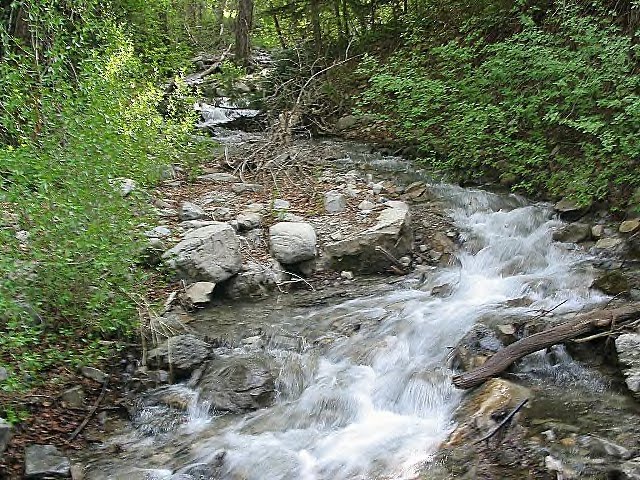
I was carrying one of them in a kid carrier, on my chest. At one point I stopped to look at a small water stream. I was looking at the stream and something unexpected happened. I heard him giggling. I looked at him and he was looking at the water stream and smiling and giggling with excitement.
And I realized he was happy appreciating the beauty of the stream.

I always thought it was very important in education to educate to appreciate beauty. I did not know how. But when I heard my son giggling at the water stream, I realized the "seed" of appreciation of beauty is already there, probably in all of us. We do not need to educate for it. We just need to expose children to beauty....and in that interaction beauty will act on the "seed"...and make it germinate....
(no need to educate, no need for sophisticated approaches and educational techniques......all the material is already there....the seed and the beauty.......and, now, writing this, I have a doubt, a question: the seed and beauty, are they different, separate, things?.....)

(dedicated to N.C.D.)

Monday, 24 January 2011

Nisargadatta Maharaj's new web site

Manu Namasivayam kindly sends me his new Nisargadatta Maharaj's web site (http://nisargadatta.co.cc/ ), which looks very complete, and there are in it several quotes from Nisargadatta that I did not know, for instance, there is a section called "The last days: Last Teachings", from where I extracted these texts:

Sunday, 9 August 1981 (he died 8th September 1981)— The same young lady wanted to know whether the practice of observing a day every week as the 'day of silence' was a good one. Maharaj smiled and said that it would be an excellent practice if the significance of the word 'silence' was clearly understood. Maharaj explained: I have heard of certain Mahatmas and Gurus, greatly interested in politics, observing 'days of silence', when they do not speak but communicate with the aid of pen and paper. I am sure their throats get a lot of much-needed rest, but other than that, I doubt if there could be any other benefit. What I would understand by 'silence' is total absence of word and thought. Have you ever considered from where the word comes? Before a word becomes vocal, it has to be a thought; a movement in consciousness, and therefore, the source of the word as well as the thought is consciousness. Once you understand this, you will also understand that perfect silence can only be in the absence of thought— only when thought ceases, and conceptualization and objectivization are also suspended. When conceptualization ceases, identity, which is the basis of conceptualization, cannot remain, and in the absence of identity there is no bondage.

Friday, 17 July 1981 — You people have been coming here hoping all the time that I would give you a programme of what you should do in order to get 'liberation.' And what I keep telling you is that since there is no entity as such, the question of bondage does not arise; and that if one is not bound there is no need for liberation. All I can do is to show you that what you are is not what you think you are.

But what I say is not acceptable to most of you. And sortie of you go elsewhere, where they are happy to be given a list of do's and dont's. What is more, they act on such instructions with faith and diligence. But what they do not realize is that whatever they practise as an 'entity' only strengthens their identification with the illusory entity and, therefore, understanding of the Truth remains as far away as ever.

People imagine that they must somehow change themselves from imperfect human beings into perfect human beings known as sages. If only they would see the absurdity in this thinking. The one who is thinking along these lines is himself only a concept, an appearance, a character in a dream. How can a mere phenomenal phantom awaken from a dream by perfecting itself?

Sunday, 23 January 2011

Steve Jobs adressing students

"Your time is limited, so don't waste it living someone else's life. Don't be trapped by dogma — which is living with the results of other people's thinking. Don't let the noise of others' opinions drown out your own inner voice. And most important, have the courage to follow your heart and intuition. They somehow already know what you truly want to become. Everything else is secondary."

(Steve Jobs, founder and creative soul of Apple Computer addressing students at Stanford University on June 12, 2005. You can read the full address in: http://news.stanford.edu/news/2005/june15/jobs-061505)