Saturday, 26 March 2011

Education XVII: what we bring from our evolutionary past

My twins are now 1 year and 15 days old. Since they were 9 month old I have observed something in their behaviour which I find very interesting.

One is playing with, say, a small bottle, he is examining it, bringing it to his mouth. Then the other sees that object and comes to take the bottle from the other twin. Then screaming breaks out and the one having the bottle bites the other in the hand or the face or even the head. Sometimes biting is quite hard and painful. Both of them show this behavior. Of course, it does not happen all the time, it is a minority of times, but it happens.

Obviously, they have not seen this behaviour from us....so this reaction is not learned but it has to come in their genes, from their evolutionary past......

Many things are involved in this kind of incidents: a sense of possesion, a sense of me (I am possesing this object and somebody else, separate, comes to take it away), and violence, come in-built in our genes....they are expressions of our evolutionary history.......is a kind of evolutionary conditioning...acting all our life.....

Tuesday, 22 March 2011

Education XVI: the world is the teacher

I was watching one of my twins trying to climb a rock. He was getting better and better at it, was quite determined about it, and showed a great joy at trying it.

And an idea came to my mind: The real techer is not a person in a school..... the real teacher is the world. All is there.

And then I thought: Yes, two elements are the main teachers, and they are enough to learn it all. One is the world, and the other the capacity to look, not only outwardly, but more importantly inwardly.........

(photograph from: http://parkerlab.bio.uci.edu/nonscientific_adventures/canyonland_arches.htm)

Tuesday, 15 March 2011

real freedom


I go to work and in the car I listen to D. Bohm and Krishnamurti dialogue number 15, towards the end of it there is a part that I found remarkable:

K: .....................It means he must listen to me, but my brother refuses to listen.

DB: It seems that there are some actions which are not possible. If a person is caught in a certain thought such as fragmentation, then he can't change it, because there are a lot of other thoughts behind it.

K: Of course.

DB: Thoughts he doesn't know. He is not actually free to take this action because of the whole structure of thought that holds him.

And that sparks an idea in my mind: "Maybe real freedom is just to listen, to listen completely, because when you listen completely, there are no thoughts, no influences from my structure, from my past......and in those moments I am free of them..........

Friday, 11 March 2011

tsunami

My afection and solidarity for everybody that is suffering by today's tsunami.....we feel close to you.....

I think we are heading towards a world that feels like a unity....

(lower picture: children in Ahmedabad, India, by Amit Dave)

Wednesday, 9 March 2011

Education XV: behaviour 2

And keeping reading an answer came, a bit in an unexpected twist:

".....So there has to be affection, a sense of tenderness, kindliness, generosity.
If there is such affection, then behaviour is dictated by that affection and is not dependent on environment, circumstance, or people. And to find that affection is one of the most difficult things .......
...... And so to have affection right through life is one of the most difficult things and without it life becomes very empty. You may have children, you may have a nice house, a car and all the rest of it, but without affection life is like a flower that has no scent. And it is part of education, is it not, to come to this affection, from which there is great joy, from which alone love can come?

Monday, 7 March 2011

Education XIV: behaviour


One of the most difficult things in life is to find a way of behaviour that is not dictated by circumstances. Circumstances and people dictate, or force you to behave in a certain way. The way you conduct yourself, the way you eat, the way you talk, your moral, your ethical behaviour depend on where you find yourself and so your behaviour is constantly varying, constantly changing.

This is so when you speak to your father, your mother or to your servant - your voice, your words, are quite different. The ways of behaviour are controlled by environmental influences, and by analysing behaviour you can almost predict what people will do or will not do.


Now can one ask oneself if one can behave the same inwardly, whatever the circumstances? Can one's behaviour spring from within and not depend on what people think of you or how they look at you? But that is difficult because one does not know what one is within. Within, a constant change is going on also. You are not what you were yesterday.

Now can one find for oneself a way of behaviour which is not dictated by others or by society or by circumstances or by religious sanctions, a way of behaviour that does not depend on environment?

(J. Krishnamurti "On Education", chapter 9)

Good point to ask ourselves and to raise in an educational setup

Friday, 4 March 2011

Education XIII

Student: If you have lots of time, how would you spend it, Sir?

Krishnamurti: I would do what I am doing. You see, if you love what you are doing, then you have all the leisure that you need in your life. Do you understand what I have said? You asked me what I would do if I had leisure. I said, I would do what I am doing; which is to go around different parts of the world, to talk, to see people and so on. I do it because I love to do it; not because I talk to a great many people and feel that I am very important. When you feel very important, you do not love what you are doing; you love yourself and not what you are doing. So, your concern should be not with what I am doing, but with what you are going to do. Right? I have told you what I am doing. Now you tell me what you will do, when you have plenty of leisure.

(Krishnamurti in "on education", chapter 8)

Saturday, 26 February 2011

Wednesday, 23 February 2011

Education XII. What is to learn from oneself and from outside?

It seems so important in education to learn about the world inside us, and the world outside......which means to "look" inside and to "look" outside.......Maybe they are not different....... it seems to me, if the looking inside and outside is the same, that is the "unifying" factor..........

This is the crucial question......how to look?

We are reading the book "on education" by J. Krishnamurti (where he is talking to young students) in the other blog, and so far there has been 3 occasions in which he describes meditation, which probably is this "looking".

Let's put these 3 pieces together to have a look at its beauty:

- "You must know fear and not escape from it so that you can look at fear. It is like going for a walk and suddenly coming upon a snake, jumping away and watching the snake. If you are very quiet, very still, unafraid, then you can look very closely, keeping a safe distance. You can look at the black tongue and the eyes that have no eyelids. You can look at the scales, the patterns of the skin. If you watch the snake very closely you see and appreciate it and perhaps have great affection for that snake. But you cannot look if you are afraid, if you run away"

- "Have you ever sat on the banks of a river and watched the water go by? You cannot do anything about the water. There is the clear water, the dead leaves, the branches. You see a dead animal go by, and you are watching all that. You see the movement of the water, the clarity of the water, the swift current of the water and the fullness of the water. But you cannot do anything. You watch and you let the water flow by"


- To learn about meditation, you have to see how your mind is working. You have to watch, as you watch a lizard going by, walking across the wall. You see all its four feet, how it sticks to the wall, and as you watch, you see all the movements. In the same way, watch your thinking. Do not correct it. Do not suppress it. Do not say, "All this is too difficult". Just watch

Friday, 18 February 2011

Education XI. Not just ideas, concepts.....

I was driving today, coming from a beautiful land, green, with a rough coastline where the sea and sky rival in beauty.
And I was listening in the car dialogue number 13th of "The ending of time" between David Bohm and J. Krishnamurti, and a section of this dialogue was something like this:

"K: So you see it is enormously difficult to be free of knowledge.

DB: We could ask, why doesn't knowledge wait until it is needed?

K: That means to be psychologically free of knowledge, but, when the need arises, to act from freedom, not from knowledge.

.........

K: That is freedom from knowledge. And being free, it is from freedom and not from knowledge that one communicates.

K:....... And if I am going to understand myself, I must be free to look."


And at that moment it flashed in my brain that we have been educated in ideas, in concepts, in opinions. A tremendous importance has been given to that, probably because this is the way our brain works...... I studied history and it was all knowledge, opinions about what had happened, who was "good" or "bad", all a virtual reality...and I realize I continue in my adult life living in a world of ideas, concepts......

Would it be possible to be aware of this and educate not giving so much importance to concepts, ideas....and educate giving importance to something real?

(No idea how, but the clarity about this need is there.....)

(photograph from the actual place described above, made yesterday by S. de Ch.)

Monday, 7 February 2011

Education X. The appreciation of beauty.

Two days ago I took my twins to the mountains. They are 10 month old. We went into a beautiful valley, there was snow, but the valley was wide and full of sun light. And it was very silent. Although both of them were at the beginning somehow agitated, slowly they quiet down, somehow they "melted" into the general quietness of the place.
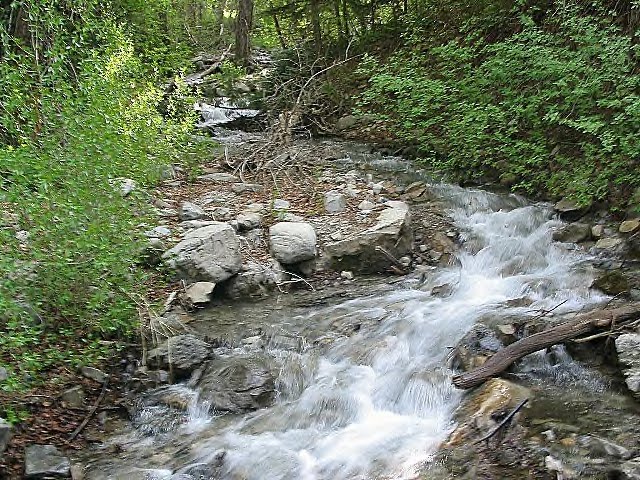
I was carrying one of them in a kid carrier, on my chest. At one point I stopped to look at a small water stream. I was looking at the stream and something unexpected happened. I heard him giggling. I looked at him and he was looking at the water stream and smiling and giggling with excitement.
And I realized he was happy appreciating the beauty of the stream.

I always thought it was very important in education to educate to appreciate beauty. I did not know how. But when I heard my son giggling at the water stream, I realized the "seed" of appreciation of beauty is already there, probably in all of us. We do not need to educate for it. We just need to expose children to beauty....and in that interaction beauty will act on the "seed"...and make it germinate....
(no need to educate, no need for sophisticated approaches and educational techniques......all the material is already there....the seed and the beauty.......and, now, writing this, I have a doubt, a question: the seed and beauty, are they different, separate, things?.....)

(dedicated to N.C.D.)

Monday, 24 January 2011

Nisargadatta Maharaj's new web site

Manu Namasivayam kindly sends me his new Nisargadatta Maharaj's web site (http://nisargadatta.co.cc/ ), which looks very complete, and there are in it several quotes from Nisargadatta that I did not know, for instance, there is a section called "The last days: Last Teachings", from where I extracted these texts:

Sunday, 9 August 1981 (he died 8th September 1981)— The same young lady wanted to know whether the practice of observing a day every week as the 'day of silence' was a good one. Maharaj smiled and said that it would be an excellent practice if the significance of the word 'silence' was clearly understood. Maharaj explained: I have heard of certain Mahatmas and Gurus, greatly interested in politics, observing 'days of silence', when they do not speak but communicate with the aid of pen and paper. I am sure their throats get a lot of much-needed rest, but other than that, I doubt if there could be any other benefit. What I would understand by 'silence' is total absence of word and thought. Have you ever considered from where the word comes? Before a word becomes vocal, it has to be a thought; a movement in consciousness, and therefore, the source of the word as well as the thought is consciousness. Once you understand this, you will also understand that perfect silence can only be in the absence of thought— only when thought ceases, and conceptualization and objectivization are also suspended. When conceptualization ceases, identity, which is the basis of conceptualization, cannot remain, and in the absence of identity there is no bondage.

Friday, 17 July 1981 — You people have been coming here hoping all the time that I would give you a programme of what you should do in order to get 'liberation.' And what I keep telling you is that since there is no entity as such, the question of bondage does not arise; and that if one is not bound there is no need for liberation. All I can do is to show you that what you are is not what you think you are.

But what I say is not acceptable to most of you. And sortie of you go elsewhere, where they are happy to be given a list of do's and dont's. What is more, they act on such instructions with faith and diligence. But what they do not realize is that whatever they practise as an 'entity' only strengthens their identification with the illusory entity and, therefore, understanding of the Truth remains as far away as ever.

People imagine that they must somehow change themselves from imperfect human beings into perfect human beings known as sages. If only they would see the absurdity in this thinking. The one who is thinking along these lines is himself only a concept, an appearance, a character in a dream. How can a mere phenomenal phantom awaken from a dream by perfecting itself?

Sunday, 23 January 2011

Steve Jobs adressing students

"Your time is limited, so don't waste it living someone else's life. Don't be trapped by dogma — which is living with the results of other people's thinking. Don't let the noise of others' opinions drown out your own inner voice. And most important, have the courage to follow your heart and intuition. They somehow already know what you truly want to become. Everything else is secondary."

(Steve Jobs, founder and creative soul of Apple Computer addressing students at Stanford University on June 12, 2005. You can read the full address in: http://news.stanford.edu/news/2005/june15/jobs-061505)

Thursday, 20 January 2011

how should a religious person live?

Today I was thinking: how should a religious person live?
How should he earn a living?

(photograph by Armit Ere)

Monday, 17 January 2011

To look at yourself


To learn about meditation, you have to see how your mind is working. You have to watch, as you watch a lizard going by, walking across the wall. You see all its four feet, how it sticks to the wall, and as you watch, you see all the movements. In the same way, watch your thinking. Do not correct it. Do not suppress it. Do not say, "All this is too difficult". Just watch; now, this morning.

(J. Krishnamurti, addressing young students in Rishi Valley, India. Passage extracted from the book "On Education")

(Dedicated to Hugo)

Saturday, 1 January 2011

New Year, Self


Let's start the new year with some chanting....

(Video from BeingnessTV)

Thursday, 23 December 2010

How strange is to be alive

Today a peculiar feeling crept into my mind: "how strange and fantastic is to be alive". Normally we are aware that we are doing something or that we want something or that we feel something ......Not the feeling of being able to do things or to think something....... No, just to be aware that one is alive.....simply that....

(from the dictionary: fan·tas·tic:
1. Quaint or strange in form, conception, or appearance.
2.
a. Unrestrainedly fanciful; extravagant: fantastic hopes.
b. Bizarre, as in form or appearance; strange: fantastic attire; fantastic behavior.
c. Based on or existing only in fantasy; unreal: fantastic ideas about her own superiority.
3. Wonderful or superb; remarkable: a fantastic trip to Europe.)

Wednesday, 15 December 2010

Impermanence II


I have been thinking a lot and looking at things under the "impermanence" optic....

In the entry "Impermanence I" of october 11th, I wrote that:

"In the millions of years of the universe existence, has there been two moments in which the universe has been identical?
Does this continuous change anything to do with impermanence? If there are not two moments in which the universe was identical, that means that there is no permanence.....not only it does not exists now, but there has never been.... That means that from the very beginning of the universe, impermanence has been a constant feature......"

And these days it seems to me that our mind, essentially, works on the premises of permanence. It is almost as if it would not consider the fact that impermanence is a kind of law...
Yesterday I got a "feeling" that was difficult to crystallize in words, but I will try here. It was something like this:
when the mind projects a future, this projection is based on permanence, it is a kind of permanence.....it does not take into account impermanence......not to take into account such an important law makes this projection a kind of unreal projection.......which makes the present the only real thing.....
Same with the so called "ego". It is a kind of "permanent" projection......

(Picture is titled "impermanence" by
Jason Theaker, http://www.flickr.com/people/photoimage/)

Saturday, 11 December 2010

dentist waiting room

One of the best things about going to the dentist is to sit in the waiting room. I always feel very relaxed, as I know I have to be there, I am not wasting time, there is not the feeling that I should be doing something else....

Yesterday I went to the dentist (my dear and admired J., it is so obvious that he tries to do the best work he can, that always when I come out I feel like doing also my best in my job). The waiting room was quite full, and the "gossip" magazines were all taken, so I had to take a kind of "scientific" magazine titled something like "Very Interesting".

And I found an article titled "how do we spend our life?", and I found it very interesting, so I asked the nurse for a pen, and I copied a graph from the article: "If a person lives 70 years, he/she spends:
- 11 years: in housekeeping (washing, cleaning, cooking, etc)
- 13 years: studying and/or working
- 17 years: free time
- 29 years: vital functions (sleeping, eating, hygiene, etc.)

So, I thought, only 17 years of free time out of 70......and something came to my mind then. If we leave the religious "practice" for our free time, kind of separate from the rest of our lives, it is a very small proportion of our life....and I remembered what Krishnamurti said: "meditation" should be all the time, even in our "normal" daily life...

Wednesday, 8 December 2010

life outside Earth


An Earth-size planet has been spotted orbiting a nearby star at a distance that would makes it not too hot and not too cold — comfortable enough for life to exist, researchers announced (Sept. 29).

If confirmed, the exoplanet, named Gliese 581g, would be the first Earth-like world found residing in a star's habitable zone — a region where a planet's temperature could sustain liquid water on its surface.

And the planet's discoverers are optimistic about the prospects for finding life there.

"Personally, given the ubiquity and propensity of life to flourish wherever it can, I would say, my own personal feeling is that the chances of life on this planet are 100 percent," said Steven Vogt, a professor of astronomy and astrophysics at the University of California, Santa Cruz, during a press briefing today. "I have almost no doubt about it."

The star is located 20 light-years from Earth in the constellation Libra. One light-year is about 6 trillion miles (10 trillion km).

Red dwarf stars are about 50 times dimmer than our sun. Since these stars are so much cooler, their planets can orbit much closer to them and still remain in the habitable zone.

Estimates suggest Gliese 581g is close enough to its star to be able to complete an orbit in just under 37 days.

With support from the National Science Foundation and NASA, the scientists — members of the Lick-Carnegie Exoplanet Survey — collected 11 years of radial velocity data on the star. This method looks at a star's tiny movements due to the gravitational tug from orbiting bodies.

The subtle tugs let researchers estimate the planet's mass and orbital period, how long it takes to circle its star.

Gliese 581g has a mass three to four times Earth's, the researchers estimated. From the mass and size, they said the world is probably a rocky planet with enough gravity to hold onto an atmosphere.

Just as Mercury is locked facing the sun, the planet is tidally locked to its star, so that one side basks in perpetual daylight, while the other side remains in darkness. This locked configuration helps to stabilize the planet's surface climate, Vogt said.

But whether Gliese 581g harbors life may not be the most striking aspect of this find. Vogt says the discovery of a potentially habitable world less than 100 light-years away means that habitable worlds may be much more common than astronomers thought. Given the number of stars in the Milky Way, Vogt explains, that could mean there are "potentially billions" of Earth-like worlds out there.


With the vastness of the universe, and the innumerable possibilities of combinations, it seems to me that the existence of life outside Earth might be not only possible, but unavoidable.... What if this life has been only 1000 years ahead of us in development? If they have gone through the challenges and difficulties we are going through now? their consciousness has gone through the evolutionary shaping process? What would be the impact on us if we could eventually communicate with such forms of life? By the way, what is life? is it something that comes up from a certain environment and evolves interacting with the evolving environment? is it just a type of manifestation in the universe?, is it separate from it?......


(This artist's conception shows the inner four planets of the Gliese 581 system and their host star, a red dwarf star only 20 light years away from Earth. The large planet in the foreground is the newly discovered GJ 581g, which has a 37-day orbit right in the middle of the star's habitable zone and is only three to four times the mass of Earth, with a diameter 1.2 to 1.4 times that of Earth. Credit: Lynette Cook) (Text and image taken from www.space.com)